File ST/01 1907 Ludhiana 1921 Lahore 1926 N.B. Sabha 1928 HSRA 1929 Arrest 1930 Tribunal 1931 23 March
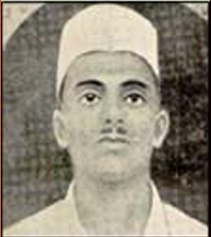
Portrait of Indian revolutionary Sukhdev Thapar, wearing a white cap and collarless white shirt, facing the viewer
Plate I  Sukhdev Thapar Modern colourised rendering

SukhdevThapar

15 May 1907, Ludhiana  —  23 March 1931, Lahore  ·  Aged 23

Not a companion to the revolution. One of the people who built it.

Sukhdev Thapar helped found the Naujawan Bharat Sabha, ran the political study circles that shaped a generation of Punjabi revolutionaries, and led the Hindustan Socialist Republican Association’s organisation in Punjab. He was hanged at Lahore Central Jail alongside Bhagat Singh and Shivaram Hari Rajguru. This archive sets out what the historical record establishes about him — and marks clearly where it does not.

Enter the file Archive open
01 —

The Portrait

Almost every image of Sukhdev Thapar in circulation today descends from a single surviving studio photograph.

Reproduction of the surviving black-and-white studio photograph of Sukhdev Thapar
Plate II  Photographic reference Low-resolution reproduction

He is one of the most reproduced faces of the Indian revolutionary movement and one of the least examined. The white cap, the collarless shirt, the level gaze — the image is familiar to the point of invisibility. Painted, colourised, printed on posters and cast in plaster, it has been repeated so often that the person inside it has thinned into a silhouette.

Sukhdev Thapar was twenty-three years old when the colonial state killed him. In the seven years before that he helped build a political organisation, taught himself and others the history of revolutions, argued fiercely about strategy with the people closest to him, and accepted the consequences of what he had helped set in motion.

This archive begins with the photograph because the photograph is where the flattening begins. What follows is an attempt to restore the record around it.

See every image in the archive

A note on the images Only a small number of photographic reproductions of Sukhdev Thapar survive in general circulation, and they are of low resolution. Many of the pictures that appear under his name are modern paintings and colourised illustrations rather than photographs. Throughout this archive, every image is captioned for what it actually is.
02 —

More Than a Name in a List of Three

Bhagat Singh, Sukhdev, Rajguru. The three names are recited together so reliably that the middle one has almost stopped meaning a person.

Public memory has given Sukhdev Thapar a fixed role: the friend. He appears in the story as the third name, the one recited between two better-known ones, present at the end and largely absent from everything before it.

The historical record describes something different. Sukhdev was an organiser — the person who did the slow, unglamorous work that makes a clandestine political organisation possible. He recruited. He ran study circles. He held the Punjab apparatus of the Hindustan Socialist Republican Association together. When the organisation argued about what to do next, he argued hard, and not always on the popular side.

He was also, by the account of the men tried alongside him, difficult, exacting and uninterested in being liked. That is not a decorative detail. It is a description of the temperament that a functioning underground organisation actually requires.

Reading him only as Bhagat Singh’s companion is not merely unfair to Sukhdev. It obscures how the revolutionary movement worked — as a structure built by many people, not a stage for one.

The argument of this archive

Sukhdev Thapar should be studied as a political organiser who chose armed revolutionary politics, not remembered only as a man who died beside someone famous.

Established fact Interpretation Disputed / uncertain

These three markers appear throughout the archive wherever the standard of evidence changes.

03 —

The Making of a Revolutionary

Ludhiana to Lahore: a childhood in a nationalist household, and a college founded as an act of political defiance.

1907 Ludhiana, Punjab

Born into a family already inside the national movement

Sukhdev Thapar was born on 15 May 1907 in Ludhiana, in the Punjab province of British India, to Ramlal Thapar and Ralli Devi. It is widely recorded that his father died while Sukhdev was very young and that he grew up substantially in the household of his uncle, Lala Achint Ram — a nationalist worker who would later sit in the Constituent Assembly of India and in the Lok Sabha.

Disputed / uncertain  Accounts differ on precisely when his father died. The substance — that Sukhdev was raised in a politically active household — is not in dispute.

1921 National College, Lahore

A college built by the Non-Cooperation Movement

National College, Lahore was established in 1921 on the initiative of Lala Lajpat Rai, as part of the Non-Cooperation Movement’s call for Indians to withdraw from government-recognised education. It was a nationalist institution by design. Its students included Bhagat Singh, Bhagwati Charan Vohra, Yashpal and Sukhdev Thapar; its teachers included Jaichandra Vidyalankar.

Established fact  The college is where Sukhdev’s lifelong political associations were formed.

1926 Lahore

The Naujawan Bharat Sabha

Sukhdev was among the organisers of the Naujawan Bharat Sabha, formed in Lahore in 1926 as an open, public youth organisation. Unlike the underground groups, it operated in the daylight: public meetings, political education, and a deliberately secular membership at a moment when communal organisation was intensifying across Punjab.

Established fact  The Sabha was the recruiting and political-education arm through which many young Punjabis entered revolutionary politics.

1928 Feroz Shah Kotla, Delhi

The HSRA, and a word added to a name

On 8–9 September 1928, revolutionaries from several provinces met in the ruins of Feroz Shah Kotla in Delhi and reorganised the Hindustan Republican Association as the Hindustan Socialist Republican Association. Sukhdev was present as one of the Punjab representatives and took charge of the organisation’s Punjab work.

Established fact  The insertion of “Socialist” was a deliberate declaration: independence was not the end point, but the beginning of a social reconstruction.

Read the full account of his early life

04 —

The Network

A revolutionary organisation is a set of relationships. These are the people the record places around Sukhdev Thapar.

Punjab organisation

Sukhdev Thapar

1907 – 1931

Organiser and recruiter; ran political study circles at Lahore; responsible for HSRA work in Punjab; among the planners of the Saunders action.

Comrade

Bhagat Singh

1907 – 1931

Fellow student at National College, co-organiser of the Naujawan Bharat Sabha, HSRA member. Tried and executed in the same case.

Comrade

Shivaram Hari Rajguru

1908 – 1931

Revolutionary from the Maharashtra region who joined the HSRA; one of the two men who fired on 17 December 1928. Executed alongside Sukhdev.

Commander, military wing

Chandra Shekhar Azad

1906 – 1931

Led the HSRA’s armed wing and remained at large after the 1929 arrests. Died in a police encounter at Alfred Park, Allahabad, on 27 February 1931.

Theorist & organiser

Bhagwati Charan Vohra

1904 – 1930

A principal author of the Naujawan Bharat Sabha’s programme and of HSRA statements. Killed on 28 May 1930 while testing a bomb near the Ravi.

Co-accused

Jatindra Nath Das

1904 – 1929

Bomb-maker and co-accused. Died on 13 September 1929 on the sixty-third day of the jail hunger strike for political-prisoner status.

Explore the network in full

05 —

Ideas Into Action

Before the actions there were reading lists. The Lahore revolutionaries were, first, a study group.

What separated this circle from earlier revolutionary groups was the seriousness with which it read. Sukhdev is consistently described in the recollections of his comrades as one of the organisers of the study circles that ran at Lahore — sessions on the Russian revolution, on the Irish struggle, on Italian unification, on socialist and anarchist writing.

The purpose was not decorative. The group was trying to answer a practical question: what actually produces a revolution, and what merely produces a martyr? Their answer shifted over the 1920s from individual heroism toward organisation, propaganda and a stated social programme — the shift that produced the word “Socialist” in the HSRA’s name in 1928.

Sukhdev’s contribution belongs to this side of the movement. He was not primarily a man of the pistol. He was the person who found the recruits, tested them, taught them, and kept the Punjab structure functioning while others travelled.

Follow the revolutionary journey

1921

National College, Lahore — founded as a nationalist alternative to government-recognised education.

1926

Naujawan Bharat Sabha — an open, secular youth organisation for mass political work.

1928

HSRA — the underground organisation adopts an explicitly socialist objective.

23

His age at execution. The oldest of the three men hanged on 23 March 1931 was twenty-four.

06 —

The Revolutionary Organisation

The Hindustan Socialist Republican Association, and what Sukhdev Thapar was responsible for inside it.

Formation

The Hindustan Republican Association had been founded in 1924. At the meeting held in the ruins of Feroz Shah Kotla, Delhi, on 8–9 September 1928, it was reorganised: a central committee was constituted, Chandra Shekhar Azad was given charge of the armed wing, and the word Socialist was written into the name.

Sukhdev’s brief

Punjab. Recruitment, political education, safe houses, the movement of people and materials, and the maintenance of the Sabha as the organisation’s public-facing arm. He is recorded as the person the Punjab structure ran through.

The strategic question

The HSRA did not believe assassinations would expel the British. Its stated logic was propaganda by deed: actions designed to be heard, followed by trials the accused would use as a public platform. Sukhdev worked inside that logic and, on at least one occasion recorded by his comrades, disagreed sharply about how to apply it.

Constituted

Hindustan
Socialist
Republican
Association

Feroz Shah Kotla, Delhi · 8–9 September 1928

Central committee constituted · armed wing under Chandra Shekhar Azad · Punjab organisation under Sukhdev Thapar

On organisational structure The HSRA operated clandestinely and left few internal records. Much of what is known about its structure comes from the prosecution case in the Lahore Conspiracy trial and from memoirs written decades later by surviving members. Both are useful; neither is neutral.

Read the full HSRA file

07 —

1928 – 1930

Twenty-eight months from a police lathi charge in Lahore to a death sentence in the same city.

30 Oct
1928
Lahore

The lathi charge on the Simon Commission protest

The Simon Commission, appointed to review India’s constitutional position without a single Indian member, was met with boycott wherever it travelled. At Lahore on 30 October 1928 the demonstration was baton-charged by police under Superintendent James A. Scott. Lala Lajpat Rai, leading the protest, was injured.

Established fact

17 Nov
1928
Lahore

The death of Lala Lajpat Rai

Lala Lajpat Rai died on 17 November 1928. His death was widely attributed in nationalist opinion to the injuries he had received. The colonial administration disputed the connection. For the Lahore revolutionaries the question was settled: a decision was taken to answer it.

Disputed  The medical causation was contested at the time and has remained so. What is not contested is that the HSRA acted on the belief that the state had killed him.

17 Dec
1928
Lahore

The shooting of J. P. Saunders

John P. Saunders, an Assistant Superintendent of Police, was shot dead outside the District Police Lines in Lahore. Bhagat Singh and Rajguru fired; Chandra Shekhar Azad covered the withdrawal. Head constable Chanan Singh, who gave chase, was also shot and died. The intended target had been Scott; Saunders was killed in his place.

Established fact  Sukhdev did not fire. He is recorded among those who planned the action — the charge on which he would later be sentenced to death.

8 Apr
1929
Delhi

The Central Legislative Assembly bombing

Bhagat Singh and Batukeshwar Dutt threw two low-intensity bombs into an empty section of the Central Legislative Assembly chamber and scattered leaflets, during the passage of the Public Safety Bill and the Trade Disputes Bill. They did not attempt to escape. Arrest was the point: the trial was the platform.

Established fact  Sukhdev Thapar was not present and took no part in this action. It is frequently and wrongly attributed to him.

Apr
1929
Lahore

The raids, and Sukhdev’s arrest

In the weeks after the Assembly action, police raids uncovered HSRA bomb-making premises at Lahore, Saharanpur and Agra. A wave of arrests followed across the organisation. Sukhdev Thapar was arrested at Lahore in April 1929. Several members subsequently turned approver, and their testimony became the spine of the prosecution case.

Established fact  Uncertain  Sources differ over the exact day in April.

7 Oct
1930
Lahore

The Special Tribunal delivers judgment

A tribunal constituted under an emergency ordinance — empowered to proceed even in the absence of the accused, and with no appeal except to the Privy Council — sentenced Sukhdev Thapar, Bhagat Singh and Rajguru to death by hanging, and other accused to transportation for life and lesser terms.

Established fact

Read what the Assembly action was — and was not

08 —

The Lahore Conspiracy Case

A proceeding in which the ordinary rules of criminal procedure were suspended by executive order.

The case brought against Sukhdev Thapar and his co-accused concerned the killing of Saunders and the wider conspiracy alleged against the HSRA. Committal proceedings opened in July 1929. From the beginning the accused treated the courtroom as a political forum, and the administration treated the proceedings as a problem to be managed.

The prisoners went on hunger strike from June 1929, demanding to be treated as political prisoners rather than as ordinary convicts. The strike ran for months and produced the movement’s most damaging single fact: on 13 September 1929, the co-accused Jatindra Nath Das died on its sixty-third day.

On 1 May 1930 the Viceroy, Lord Irwin, promulgated an ordinance constituting a Special Tribunal of three judges to try the case. The tribunal could proceed in the absence of the accused and without their counsel; the ordinary right of appeal to the High Court was removed, leaving only the Privy Council. The accused refused to participate in a proceeding constituted on those terms.

Judgment was delivered on 7 October 1930. The appeal to the Privy Council was dismissed in February 1931.

Read the case file

Ordinance

1 May 1930

A tribunal of three judges, constituted by executive ordinance. Trial may proceed ex parte. No appeal but to the Privy Council.

Judgment

7 October 1930

Death by hanging for Sukhdev Thapar, Bhagat Singh and Shivaram Hari Rajguru. Transportation for life and lesser sentences for other accused.

Why the ordinance matters The colonial government did not lose this case within the ordinary law — it changed the law to try it. That fact is central to how the trial has been assessed by historians since.
09 —

The Final Days

The sentence was carried out on the evening of 23 March 1931, a day earlier than scheduled.

Through the winter of 1930–31 the three condemned men remained in Lahore Central Jail while appeals and petitions ran their course. The Privy Council dismissed the appeal in February 1931. On 5 March 1931 the Gandhi–Irwin Pact was concluded; it did not commute the sentences.

A letter attributed to Sukhdev Thapar and addressed to Mahatma Gandhi was published after his death. It questioned what the truce meant for revolutionaries already in prison and argued against any call for the revolutionary movement to suspend its work. Its authorship is accepted by most historians; because published texts vary, this archive describes it rather than quoting it.

The executions were carried out at Lahore Central Jail on the evening of 23 March 1931, approximately eleven hours before the scheduled hour and a day ahead of the notified date. The bodies were removed from the jail and taken to Hussainiwala on the bank of the Sutlej, where they were cremated.

Sukhdev Thapar was twenty-three years old.

Recorded

23 March 1931 · Lahore Central Jail · evening

Execution advanced by roughly eleven hours; no public notice given beforehand.

Remains taken to Hussainiwala, Firozpur district, and cremated on the bank of the Sutlej.

Contested details Several widely repeated details of the night — the exact minute of the hanging, the precise route the bodies took, and the condition in which remains were returned to the families — rest on later testimony and differ between accounts. This archive records the events that the sources agree on and marks the rest as contested.

Read the record of 23 March 1931

10 —

The Legacy

What a state does with the people it once hanged, and what remembering costs when it becomes automatic.

The executions produced immediate and widespread protest across India. At its Karachi session later that same March, the Indian National Congress — while restating its position against political violence — recorded its admiration for the courage and sacrifice of the three men. The colonial administration had removed three prisoners and created a permanent political fact.

Sukhdev Thapar is now commemorated in the ordinary machinery of Indian public life: 23 March is observed as Shaheed Diwas; the national memorial at Hussainiwala marks the site of the cremation; a major inter-state bus terminal in his home city of Ludhiana carries his name; his family’s house in the Naughara locality of Ludhiana has been the subject of repeated preservation demands.

Commemoration of this kind is real, and it is also a form of forgetting. A name on a terminus is not an argument. The harder work — reading what these men actually wrote, understanding the organisation they built, and taking seriously the political programme they died holding — is the part that is most often skipped.

Read how he has been remembered

01

Hussainiwala

The National Martyrs Memorial in Firozpur district, Punjab, at the site on the Sutlej where the three were cremated. A fair is held there each 23 March.

02

Ludhiana

His birthplace. The Shaheed Sukhdev Thapar Inter-State Bus Terminal carries his name; the family house at Naughara still stands.

03

23 March

Observed across India as Shaheed Diwas — Martyrs’ Day — marking the date of the executions.


In closing

A country decides what it is by deciding whom it agrees to remember accurately.

Sukhdev Thapar was not a symbol. He was a young man who read carefully, organised patiently, argued with his closest friends, and did not step back from the consequences. That is a harder thing to commemorate than a face on a poster — and a more useful one.