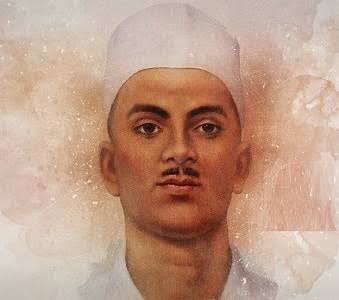
A birth in Ludhiana
Sukhdev Thapar was born on 15 May 1907 in Ludhiana, in the Punjab province of British India. His parents were Ramlal Thapar and Ralli Devi. The family was of modest means and unremarkable standing — which is to say that nothing about his birth marked him for the life he had.
It is widely recorded that his father died while Sukhdev was still an infant, and that the boy was brought up substantially within the household of his uncle, Lala Achint Ram. This detail matters more than a genealogical footnote, because Achint Ram was not a bystander to the national movement. He was an active nationalist worker who would go on, after independence, to sit in the Constituent Assembly of India and in the Lok Sabha.
Disputed / uncertain Accounts vary on exactly when Ramlal Thapar died — some place it shortly before Sukhdev’s birth, others in his early infancy. The substance is not contested: Sukhdev grew up in a household where opposition to British rule was ordinary conversation rather than a discovery made in adolescence.
He was not, in other words, radicalised. He was raised.
The year Punjab did not forget
Sukhdev was eleven years old in the spring of 1919. In March, the Rowlatt Act extended wartime emergency powers into peacetime, permitting detention without trial. Protest spread across Punjab. On 13 April 1919, at Jallianwala Bagh in Amritsar, troops under Brigadier-General Reginald Dyer fired without warning on an enclosed public meeting. Hundreds were killed; the official and unofficial counts have never been reconciled.
What followed was, for Punjabis, as formative as the massacre itself: martial law across the province, public floggings, the notorious order at Amritsar requiring Indians to crawl along a street where a British woman had been assaulted, and a commission of inquiry whose findings satisfied almost no one.
Interpretation No document records what an eleven-year-old in Ludhiana thought about any of this. What can be said with confidence is structural rather than personal: the generation of Punjabi revolutionaries born between 1904 and 1910 reached political consciousness inside the aftermath of 1919, and their politics were shaped by the conclusion that constitutional protest had been answered with gunfire.
National College, Lahore
In 1921 the Non-Cooperation Movement asked Indians to withdraw from institutions that carried the colonial state’s recognition — its courts, its titles, its schools. Students who walked out of government-affiliated colleges needed somewhere to go. National College, Lahore was founded that year on the initiative of Lala Lajpat Rai to receive them.
It was a nationalist institution by intention and by staffing. Among its teachers was the historian Jaichandra Vidyalankar, whose teaching of comparative national movements is repeatedly credited in the recollections of his students. Among the students of those years were Bhagat Singh, Bhagwati Charan Vohra, the writer Yashpal — and Sukhdev Thapar.
This is the single most consequential fact of his education. He did not meet his political comrades at a meeting or through a recruiter. He met them in a classroom, in a college built specifically to produce people who would refuse the colonial state.
What they actually studied
Alongside the formal curriculum, the group organised its own reading. The recollections of surviving members describe study circles working through the Russian revolution, the Irish independence struggle, Italian unification, and socialist and anarchist writing — not as inspiration, but as case material. The question under examination was technical: what combination of organisation, propaganda and action has actually overturned a state, and what has merely produced funerals?
Interpretation These study circles are described consistently across several memoirs written by men who were there, including accounts published long after 1931. They are well attested, but they are recollection rather than contemporaneous record, and the emphasis differs between tellings.
The inheritance: Ghadar
The Lahore students were not the first Punjabi revolutionaries, and they knew it. The Ghadar Party, formed among Indian emigrants on the Pacific coast of North America in 1913, had attempted to organise an armed rising in Punjab during the First World War. It failed. The state’s response was a series of conspiracy trials at Lahore in 1915 — proceedings that sent men to the gallows and to the Andaman penal settlement.
Among those hanged in 1915 was Kartar Singh Sarabha, who was nineteen. His example is documented as a direct influence on Bhagat Singh, and the Ghadar precedent hangs over the whole Lahore circle: the memory of an armed attempt, its defeat, and the machinery of the conspiracy trial that followed it.
The 1915 proceedings against the Ghadarites were also called the Lahore Conspiracy Case. The case in which Sukhdev Thapar was tried, fifteen years later, is for this reason sometimes distinguished in the historical literature as the Second Lahore Conspiracy Case. The repetition of the name is not a coincidence of filing. It reflects a colonial administration reaching for the same legal instrument against the same province a second time.
Political awakening becomes political work
By the middle of the 1920s the Lahore group had moved from study to organisation. In 1926 the Naujawan Bharat Sabha was formed at Lahore, and Sukhdev was among its organisers alongside Bhagat Singh, Bhagwati Charan Vohra and others.
The Sabha was deliberately public. It held open meetings, circulated political literature, and organised young men in the towns of Punjab. Two of its features were pointed choices rather than administrative details. First, it was explicitly secular — formed at a moment when communal organisation was hardening across Punjab, and structured to cut across it. Second, it addressed itself to youth and to workers and peasants, not to the professional and landholding classes who dominated constitutional politics.
This is where Sukhdev’s distinctive contribution begins to be visible. He is described in the record not as a speaker or a writer of manifestos but as the person who did the organisational work: identifying recruits, testing them, teaching them, and keeping the structure intact.
The turn to the underground
The Naujawan Bharat Sabha was the surface. Beneath it, the same people were moving into the clandestine organisation that would be reconstituted in September 1928 as the Hindustan Socialist Republican Association. Sukhdev was present at the Delhi meeting that reorganised it, as one of the Punjab representatives, and took responsibility for its work in the province.
He was twenty-one years old. He had four years to live, and in that time the organisation he helped run would carry out the action that killed him.